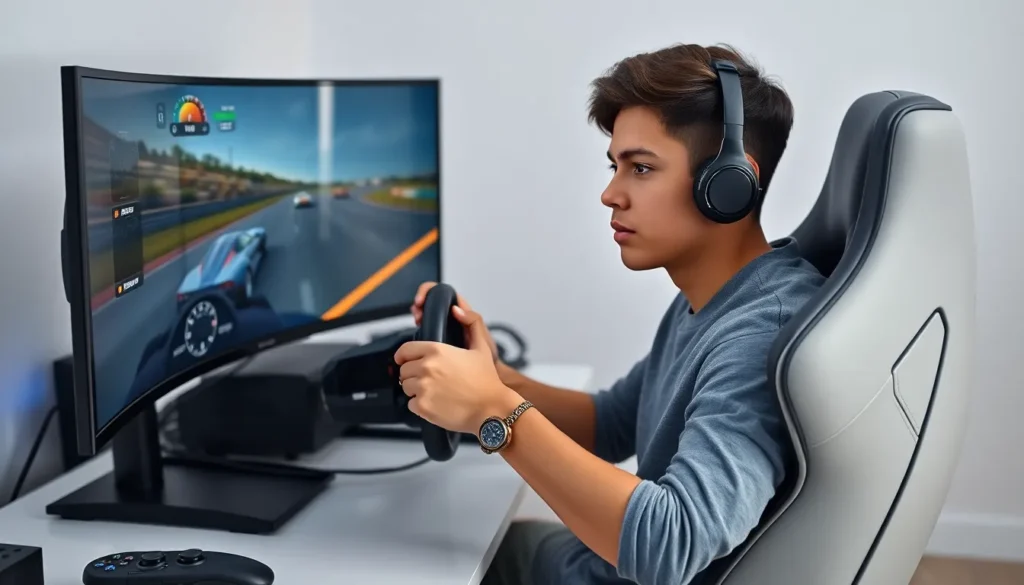

Learning how to play racing games can feel overwhelming at first. New players often struggle with controls, car handling, and track memorization. But here’s the good news: racing games reward practice more than raw talent. Whether someone picks up a controller for the first time or switches from casual to competitive play, the fundamentals remain the same. This guide breaks down everything beginners need to know, from basic controls to advanced techniques that shave seconds off lap times. By the end, readers will have a clear roadmap to improve their racing game skills and actually enjoy the process.
Table of Contents
ToggleKey Takeaways
- Start with arcade racing games like Forza Horizon or Mario Kart to build foundational skills before advancing to simulations.
- Master the racing line—enter corners wide, hit the apex, and exit wide—to maintain higher speeds through turns.
- Use in-game assists like traction control and steering assistance as training wheels, then gradually disable them as you improve.
- Focus on corner exit speed rather than entry speed, since faster exits lead to higher straightaway speeds.
- Practice tracks without opponents first to memorize braking zones and racing lines before competing online.
- Avoid overdriving—smooth, consistent laps beat aggressive driving and produce faster overall times.
Understanding Racing Game Controls and Mechanics
Every racing game shares a core set of controls. Players use steering, acceleration, and braking as their primary inputs. Most games map acceleration to a trigger or button, while steering uses either a joystick, D-pad, or wheel peripheral. Braking typically sits on the opposite trigger from acceleration.
But racing games differ in how they handle these inputs. Arcade-style games like Mario Kart or Need for Speed offer forgiving physics. Players can slam into walls, recover quickly, and still finish strong. Simulation games like Gran Turismo or Assetto Corsa punish mistakes harshly. Hit a curb wrong, and the car spins out.
Understanding a game’s mechanics matters more than memorizing button layouts. Some racing games feature assists like auto-braking, traction control, and steering assistance. New players should start with these assists enabled. They act as training wheels, helping beginners learn tracks without constant frustration.
Throttle control deserves special attention. Many beginners hold full acceleration at all times. This approach works in arcade racers but fails in simulations. Learning to feather the throttle, applying partial acceleration through turns, separates good players from great ones.
Racing games also include transmission options. Automatic transmission lets the game shift gears. Manual transmission gives players direct control. Beginners should stick with automatic until they feel comfortable with other mechanics. Switching to manual later can provide a competitive edge, since well-timed shifts improve acceleration out of corners.
Choosing the Right Racing Game for Your Skill Level
Not all racing games suit every player. Beginners often make the mistake of jumping straight into hardcore simulations. They get frustrated, quit, and assume they’re bad at racing games. The truth? They just picked the wrong starting point.
Arcade racing games offer the best entry point. Titles like Forza Horizon, Need for Speed, and Mario Kart prioritize fun over realism. Cars handle predictably. Crashes don’t end races. These games teach basic racing concepts, racing lines, drafting, and boost management, without overwhelming new players.
Simcade games sit in the middle. Forza Motorsport and Gran Turismo blend realistic physics with accessible controls. Players can adjust difficulty settings and assists to match their skill level. These games work well for players who’ve outgrown pure arcade racers but aren’t ready for full simulations.
True simulation racing games demand commitment. iRacing, Assetto Corsa Competizione, and rFactor 2 model real-world physics with extreme accuracy. Tire wear, fuel consumption, and weather conditions all affect performance. These games reward hundreds of hours of practice. They’re fantastic for dedicated players but frustrating for beginners.
Consider available hardware too. Racing games play fine with standard controllers. But simulation racers benefit hugely from racing wheels and pedals. If someone owns only a controller, they’ll enjoy arcade and simcade games more than pure simulations.
The best approach? Start arcade, graduate to simcade, then try simulations. This progression builds skills naturally without discouraging early progress.
Essential Techniques for Faster Lap Times
Speed in racing games comes from consistency, not heroics. Fast players hit the same marks lap after lap. They rarely crash. They rarely overcorrect. Mastering a few key techniques dramatically improves lap times.
The racing line matters most. Every track has an optimal path through each corner. Generally, this means entering wide, hitting the apex (the innermost point of the turn), and exiting wide. This line allows higher speeds through corners because it creates the gentlest curve possible.
Practice mode exists for a reason. New players should spend time learning tracks without opponents. Turn on the racing line assist if the game offers one. It shows the optimal path in real time. Once the line becomes automatic, turn off the assist and rely on muscle memory.
Drafting, also called slipstreaming, provides free speed. Following closely behind another car reduces air resistance. This technique works especially well on long straights. Get close, build extra speed, then pull out and pass before the next corner.
Braking and Cornering Fundamentals
Braking separates beginners from intermediate players. Most new racers brake too late and too hard. They lock up tires, miss apexes, and lose seconds per lap.
The key principle: brake in a straight line before the corner. Trail braking, gradually releasing the brake while turning in, comes later. For now, focus on completing all braking before the steering wheel turns.
Corner entry speed matters less than corner exit speed. Many beginners enter too fast, struggle through the turn, and exit slowly. Better players enter slower, maintain control, and accelerate earlier out of the corner. Since straightaways follow most corners, faster exits mean higher top speeds before the next braking zone.
Apex timing varies by corner type. Slow corners benefit from late apexes, turning in later and accelerating sooner. Fast sweeping corners use geometric apexes, the mathematical center of the turn. Learning which approach fits each corner takes time but pays dividends.
Common Mistakes to Avoid as a New Player
New racing game players repeat the same errors. Recognizing these patterns helps beginners improve faster.
Overdriving tops the list. Beginners push too hard, too soon. They attack every corner at maximum speed and crash constantly. Smooth, consistent driving beats aggressive, erratic driving every time. Slowing down often means faster lap times.
Ignoring assists hurts progression. Some players disable all assists immediately because they think assists are “cheating.” This approach backfires. Assists help players learn tracks and build confidence. Turn them off gradually as skills improve.
Chasing opponents instead of racing the track causes problems. New players fixate on the car ahead. They copy bad lines, brake at wrong points, and make reactive mistakes. Focus on personal execution first. Faster lap times naturally produce better race results.
Skipping practice slows improvement. Racing games reward track knowledge heavily. Players who practice each circuit before racing online perform dramatically better. Even fifteen minutes of practice laps helps.
Using wrong camera angles affects performance more than people realize. Hood or cockpit views offer better spatial awareness than chase cameras. Many players resist switching because chase cameras feel more natural. Try hood view for a week, most players never switch back.
Neglecting car setup limits potential in simulation-focused games. Default setups work okay but don’t maximize performance. Learning basic tuning, tire pressure, suspension stiffness, gear ratios, provides noticeable advantages. Many racing games include community-shared setups that beginners can download and use.